
Published on 11th March 2026
4 Strategic Priorities Shaping Professional Training in 2026
Professional training leaders are stewards of trust for their profession. Whether you run a membership association, a qualification body, or a training organization, your promise is the same: learning should lead to real capability and readiness in the real world, not just on paper.
In today’s world, learners expect modern, digital, personalized learning experiences so they can surface the right guidance quickly. At the same time, boards and employers want clearer proof that learning is building real capability, not just delivering completions.
In this blog, we unpack the four strategic priorities for professional training leaders that are defining learner success, program credibility and sustainable growth in 2026.
What’s Shaping the Professional Training Landscape?
Across both membership associations and training organizations, the same pattern keeps emerging: expectations are moving faster than traditional learning models can adapt. The shared reality is a widening digital learning gap across professional training.
For membership associations, renewals are increasingly being shaped by the digital experience. Learners arrive with very different levels of experience. Yet, many programs still assume a linear path with fragmented content that members struggle to navigate. Meanwhile, grey-market providers are moving faster with slick, exam- focused prep that feels more accessible. So, associations are under more pressure than ever before to modernize learning, demonstrate member value and prove impact.
For training organizations, demand for scalable online qualifications and micro-credentials is strong. However, getting programs to market (and keeping them current) is often slow and resource-heavy. At the same time, buyers increasingly expect proof of readiness, progression and ROI.
In 2026, the challenge is delivering smarter, adaptive training that scales efficiently and generates the insight needed to improve performance and protect margin.
4 Priorities for Professional Training Leaders in 2026
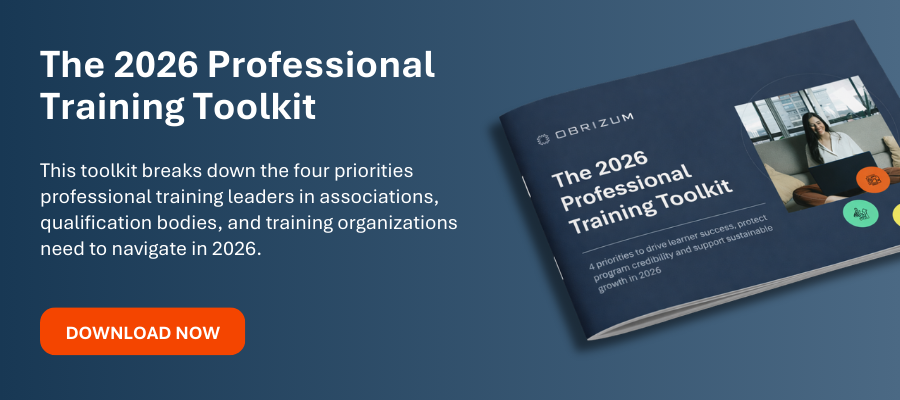
How can leaders close the digital learning gap in professional training? The following four priorities will help you drive learner success, protect program credibility and support sustainable growth. To dive deeper into these trends and explore practical guidance for professional training leaders, download Obrizum’s 2026 Professional Training Toolkit.
1. A Modern Digital Experience
Most learners quickly form a quick impression of whether your learning experience feels modern and aligned with how they expect to learn today. When it doesn’t, engagement and loyalty can weaken.
Community Brands’ 2024 Association Trends report shows that when members view their association as an early adopter of technology, they are:
• 81% more satisfied
• 74% more likely to be promoters
• 53% more likely to feel connected to the organization
Your digital learning environment is also where learners compare value. If learning feels fragmented or difficult to navigate, many turn to exam-prep platforms, CPD marketplaces or micro-credentials that feel faster and easier to access.
To close this digital learning gap, many organizations are moving toward learning environments that make expertise easier to find and return to. Obrizum’s Knowledge Spaces reflect this shift by bringing resources together into a single searchable environment – a dynamic map of how topics and content genuinely connect. So, learners can progress through training while quickly accessing guidance when it matters most.
2. Meaningful Personalization
Professional training is increasingly judged against the digital products people use every day.
Learners expect experiences that feel as personalized as Spotify playlists or Netflix recommendations. One-size-fits-all training no longer works when learners are time-poor and starting from very different levels of knowledge and confidence.
This is especially true as 55% of members now pay their own dues. Many who currently have employer-funded membership say they would reassess it if they had to pay themselves.
Generic programs can slow progression. Strong learners are forced through content they already know, while less confident learners become overwhelmed.
This is why adaptive learning is becoming central to modern professional training. When learning adapts to a person’s knowledge and confidence levels, they can focus on the gaps that matter most, skip what they already know and build readiness faster, without lowering standards.
3. Value Across the Learner Lifecycle
Professional learning supports many moments across a person’s career – exam preparation, regulatory change, skill development and ongoing CPD.
But many learning ecosystems still treat learners as a single audience, even though they enter at different stages with different goals.
This disconnect is clear in Community Brands’ data: 45% of members say career advancement is very important. Yet, only 27% of association professionals believe members value it that highly.
When learning only feels useful at one moment, professionals engage when required and then disappear. But when progress is visible across the whole learning lifecycle, engagement continues.
Leading organizations are therefore connecting entry, readiness, progression and CPD into a coherent learning journey, while also supporting quick, in-the-moment guidance when professionals need it most.
4. Credible Learning Insight
Strategic modernization and AI readiness are becoming board priorities.
Board support for AI initiatives has already reached 61% (up from 23% in 2024) and many organizations are developing formal AI policies. However, many learning programs still rely on surface-level metrics such as completions, attendance and satisfaction.
These rarely answer the questions leaders are hearing:
• Where do learners struggle?
• What content drives mastery?
• How ready are professionals in practice?
Without credible learning insight, improving programs and governing AI becomes a big challenge.
Obrizum addresses this through an AI-native foundation for learning analytics, providing three layers of insight:
• Content analytics to show what drives learning outcomes
• Real-time learner analytics to personalize experience
• Manager analytics to evidence readiness, gaps and ROI
The result? Faster improvement cycles, clearer proof of impact and stronger differentiation in your learning.
The Opportunity for Professional Training Leaders
In 2026, professional training leaders are being pulled in two directions at once: learners expect faster, more modern and personalized experiences, while boards and employers expect clearer proof that learning is building real readiness and capability.
This is the shift Obrizum’s AI-native, true adaptive learning platform was built for. For leaders, Obrizum provides credible learning insight: you can see which content works best, where learners get stuck, how confidence shifts over time and how learning translates into real outcomes. For learners, it supports both progression and ‘just-in-time’ help in the moments that matter, with reporting that strengthens governance as AI expectations rise.
” The opportunity is clear: leaders who act now can make learning engaging, personal and measurable through true adaptive learning and intelligent, just-in-time access to your expertise – and learner success, credibility and growth for your organization will follow.”
– Keith Waitt, Former Head of Professional Learning at CFA Institute, ex-Citibank global training leader and board advisor
To explore how true adaptive learning can support your qualifications, CPD or professional development programs, get in touch with Obrizum to book a demo.